Vampire
Overview
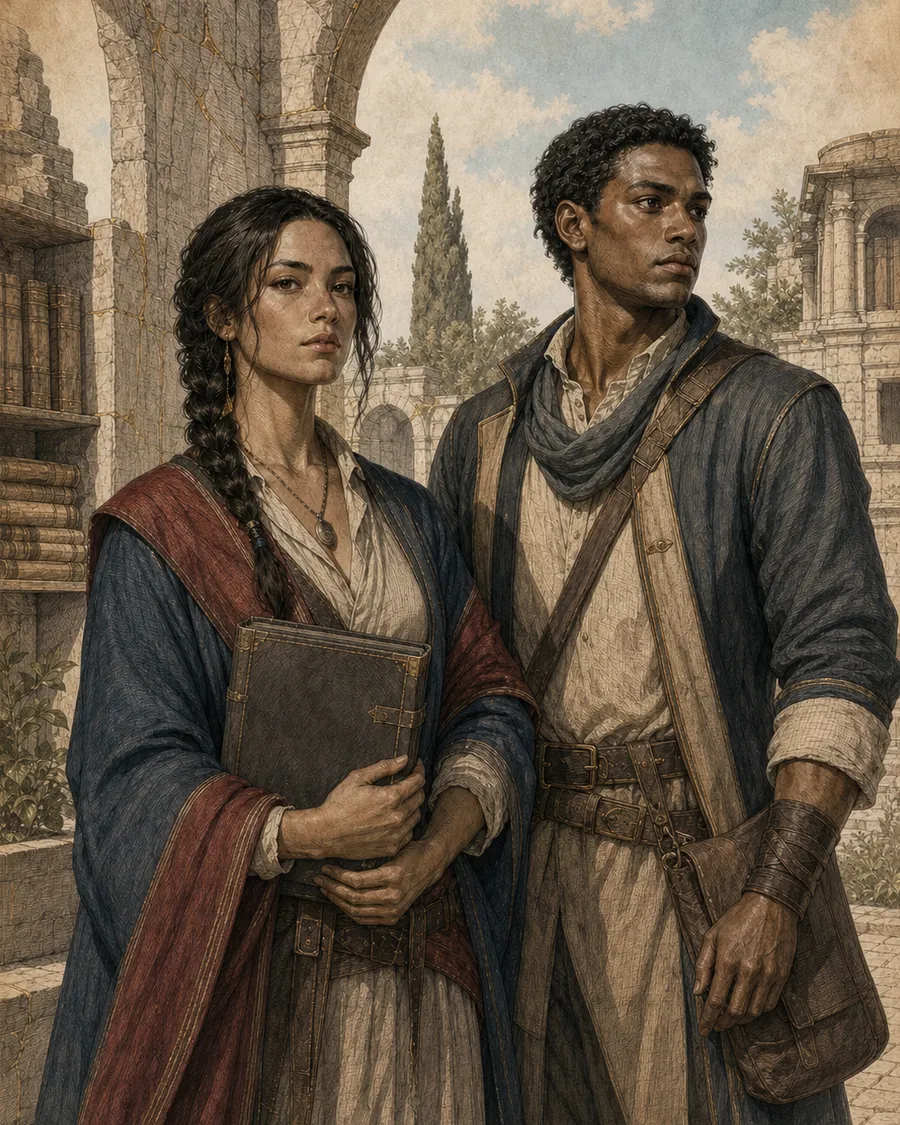
Vampires are blood-sustained beings shaped by centuries of survival, discipline, and hunger. They are not mindless undead and not simple monsters. They are conscious people whose existence requires careful management of appetite, restraint, and time.
In the old age, vampires were the ruling class of ELDRA. Their authority was built on a shadow-faith taught as cosmic truth, and the institutions of that order shaped every region they reached. That order fell during the war of revelation. The central crystal of the old faith was destroyed. The aristocratic structures that depended on it collapsed. Vampire society has been rebuilding itself ever since, and the rebuilding has produced two distinct present-era societies.
Surface vampires live in the reconstruction age under a new bloodline phenomenon that allows vampires to be born rather than only turned. This is the most important religious and political development in their recent history. The bloodline is treated as sacred because vampire continuity now depends on it rather than on the old shadow institutions. Surface communities have re-formed around the bloodline’s ongoing presence, and many of the cruelties that defined the old aristocracy (mandatory blood-tithes, forced turnings, spawn creation) are now restricted, illegal, or socially forbidden.
Abyssal vampires are the descendants of an older vampire faction that withdrew into the upper Abyss during the war and built a separate civilization there. Their society is governed through contract, pact discipline, and the practical knowledge of how to live in shadow-rich conditions. They acknowledge the new bloodline as a real phenomenon but do not depend on it; their society regenerates through their own arrangements with abyssal powers.
A small number of vampires belong to neither society. Some are independent operators, scholars, or wanderers. A few belong to the Hollow Shadow, an underground remnant of the old faith that refuses to accept the reconstruction. The Hollow Shadow is watched closely by present-era institutions.
A vampire’s morality is not determined by their kind. A vampire may be a priest, scholar, criminal, envoy, soldier, recluse, or protector of a community that does not entirely trust them.
Appearance
Vampires usually resemble the people from whom their line descends, but their bodies carry visible differences: cool skin, sharpened eyes, controlled stillness, predatory grace, and reactions to blood, moonlight, and sunlight that ordinary mortals do not share. Born-vampires often look less corpse-like than old turned vampires, though hunger, age, and blood discipline can make any vampire unsettling.
Age and Lifespan
Vampires do not usually die from age, but they are not deathless. Hunger, sunlight sensitivity in some lineages, violence, bloodline instability, magical injury, and political execution all remain real dangers. Surface born-vampires can grow from childhood to maturity, while turned vampires begin vampire life at whatever age they were transformed. A vampire who survives can exist indefinitely, but long survival requires discipline, community, secrecy, or power.
Culture and Religion
Vampire society in the reconstruction age is shaped by two facts: the old order is gone, and the new bloodline phenomenon has changed what vampires are to each other.
Surface vampire society is built around the bloodline. Communities organize themselves around the protection of birthing spaces, the recording of new generations, and the patient work of replacing the cruelties of the old aristocracy with arrangements appropriate to a vampire population that can renew itself naturally. Blood is still essential. It is no longer organized through mandatory tithes extracted from controlled mortal populations. Modern surface communities use negotiated arrangements, donor relationships, contractual feeding, blood markets, medical cooperation with mortal institutions, and other practices that vary widely by region and culture. Some surface communities maintain strict religious discipline around the bloodline. Others are more secular, treating the bloodline as a fact of nature rather than a sacred presence.
The bloodline’s religious significance is the closest thing surface vampire society has to a unifying faith. It is not the worship of a person. The bloodline is treated as an ongoing miracle, a present continuity, the reason vampire existence has survived the collapse of the old order. Different communities express this differently. Some maintain birthing temples. Some treat each new generation as a sacred event. Some quietly fold the bloodline into older rites that no longer have their original object. The common thread is that surface vampires regard the bloodline as the source of their future, not the residue of their past.
Abyssal vampire society is organized through written contract and pact discipline. Authority is distributed across a council structure rather than concentrated in a single monarch. Public life is dense with formal agreements: hunting rights, territorial obligations, blood-sharing arrangements, mutual defense pacts, and the precise documentation that abyssal society treats as a near-religious practice. The abyssal vampires acknowledge the new bloodline as a genuine phenomenon and as the foundation of surface society, but their own continuity is maintained through arrangements with abyssal powers, traditional turnings, and disciplined population planning. Cross-society marriages and exchanges occur but are rare and politically sensitive.
The old vampire faith survives only as the Hollow Shadow, an underground remnant scattered across the continent. Its adherents refuse to accept that the old shadow order ended and continue to practice rites built around a cosmology that the war broke. Surface and abyssal vampire institutions both treat the Hollow Shadow as a serious problem: politically, because its members reject the present settlement, and personally, because Hollow Shadow operatives sometimes target born-vampires to disrupt the bloodline they consider a betrayal of the true faith. Adventurers may encounter Hollow Shadow agents as antagonists in many present-era stories.
Spawn creation is now restricted across most of the vampire world. The old practice of forcibly turning humans and binding them as obedient servants was central to the pre-war aristocracy. Surface society has formally outlawed it. Abyssal society permits it only under documented circumstances, with the spawn’s eventual freedom defined in advance. Spawn remain real and dangerous; they are produced illegally in hidden facilities and by old aristocrats who never accepted the new order. Encountering bound spawn in the present era is generally a sign that something seriously wrong is happening nearby.
Religion across the two societies. Surface vampires center their religious life on the bloodline. Abyssal vampires center theirs on the discipline of agreement, with strong overlap with the demonic Pact-Bond. Individual vampires of either society may also practice other faiths: a born-vampire who grew up among rural human communities may keep folk traditions; an abyssal vampire may study the Crafted Word with elven scholars; an independent vampire may belong to no organized faith at all. The reconstruction age has made multi-tradition religious life among vampires more common, not less.
Birth, Turning, and Spawn
Surface born-vampires are free-willed vampires born through the new bloodline. They are the default present-era playable vampire. Their bodies belong to the reconstruction age rather than the old shadow order, and they do not suffer the old vampire weakness to direct sunlight.
Abyssal vampires are vampires whose society developed through abyssal contracts, survival discipline, and life in the upper Abyss. They are free-willed vampires and may be born or turned depending on lineage, but their bodies remain adapted to shadow, pact-magic, and abyssal conditions. They retain sunlight sensitivity, but gain abyssal benefits described below.
Turned vampires are created through ritual transformation. In the reconstruction age this is rare, heavily controlled, and politically sensitive. A player who wants to be a turned vampire should decide whether they belong to the old era, abyssal society, a sanctioned modern case, or an illegal transformation.
Vampire Spawn are bound servants created by domination rites. They are not a normal player option unless the Game Master explicitly allows it. Spawn creation is illegal in most surface vampire society and strongly associated with old aristocrats, hidden fanatics, and forbidden facilities.
When creating a vampire character, choose whether you are a Surface Born-Vampire or an Abyssal Vampire. A turned vampire normally uses the Abyssal Vampire sunlight profile unless the Game Master rules that a rare sanctioned transformation has been fully stabilized by the surface bloodline.
People-Specific Traits
Vampires count as both humanoid and undead. They are resistant to necrotic damage and immune to disease. They do not need to eat or breathe, and mortal food tastes bland and unsatisfying.
Vampires have darkvision and can see dim light up to 20 meters as bright and darkness as dim grayscale.
Bite. Vampires may use their Bite as an action. This requires an attack roll using the Fight skill and deals necrotic damage equal to 1 + Vampirism skill level. A successful Bite counts as one ration of blood. The vampire may choose to deal no damage. After using Bite, the vampire cannot take another action or reaction for the rest of the round.
Claws. Vampire claws are natural weapons. Unarmed strikes deal an additional Nd4 physical damage, where N = floor(Vampirism skill/2).
Sunlight and Lineage
Surface Born-Vampire. You do not suffer mechanical harm from direct sunlight. Bright sunlight may still be uncomfortable, theologically meaningful, or socially unusual for older vampires to witness, but it does not deal stress points, impose Disadvantage, or prevent your regeneration. This is one of the clearest signs that the surface born-vampire bloodline belongs to the reconstruction age.
Abyssal Vampire. You suffer under direct sunlight. While in direct sunlight, you take Physical Stress points equal to your Vampirism skill level at the end of each of your turns and suffer Disadvantage on all skill checks. Your regeneration and mist-form defenses do not function against this sunlight damage.
In exchange, you gain the following abyssal benefits:
-
Abyssal Adaptation. You gain +1 Elemental Defense against Fire damage and effects created by demons, abyssal terrain, or pact-magic.
-
Pact-Literate. You gain Advantage on Lore, Influence, or Resolve checks made to understand, negotiate, resist, or enforce demonic pacts and abyssal contracts.
-
Abyssal Step. Once per scene, while in dim light, darkness, heavy mist, or the Abyss, you may spend 1 AP to move up to 6 meters to an unoccupied space you can see without provoking reactions.
Present-era note: Surface vampire communities no longer organize all public life around fear of the sun, though their rites still honor moon cycles, bloodline records, and protected birthing spaces. Abyssal vampire communities remain built around shade, controlled crossings, enclosed architecture, and the practical knowledge that the new sun is not kind to them.
Blood Consumption
Blood is essential for vampire survival and power. Vampires accumulate Blood Points (BP) by feeding.
A vampire loses 1 Blood Point at the beginning of each day.
The maximum number of Blood Points a vampire can store is:
Max BP = N x N, where N is the Vampirism skill level.
Vampires gain 1 BP whenever they deal damage with a Bite. Blood Points fuel vampiric abilities, stunts, and special effects.
The maximum number of Blood Points that may be spent in a single turn is equal to the vampire’s Vampirism skill level. A vampire cannot use the same Blood ability more than once per turn.
Sample Blood Abilities
| Cost | Ability | Effect |
|---|---|---|
| 1 BP | Regeneration | Recover 1d4 + Vampirism skill stress points for 1 AP. |
| 1 BP | Vampiric Reflex | Reroll a failed Fortitude, Reflex, or Resolve defend roll. |
| 1 BP | Blood Dash | Move 4 meters for 0 AP without provoking attacks (1/round). |
| 1 BP | Blood Magic Surge | Reduce spell cost by 1 Mana (minimum 1). |
| 3 BP | Sanguine Strike | Add half Vampirism level, rounded up, as Necrotic damage to an attack. |
| 4 BP | Blood Frenzy | Make an extra Attack or Bite for 0 AP. |
| 5 BP | Blood Resurrection | When you are Taken Out, spend 3 AP to recover 4d4 + Vampirism skill stress points and revive on your next turn. You may also heal one Consequence of your choice. Once per long rest. |
Vampire Stunts
A Vampire gains a number of free People stunts equal to their effective Vampirism. Choose that many distinct stunts from the Vampire Stunts on this page and/or the Vampirism Stunts in the Skills section. These choices do not use general stunt slots, and the same stunt cannot be chosen more than once. If effective Vampirism changes, adjust the number of chosen stunts with the GM.
Crimson Resilience. When you would take physical damage, reduce it by half your Vampirism skill level, rounded up. This may be used a number of times per long rest equal to your Vampirism skill level.
Blood Echo. When you deal necrotic damage to a creature, mark it until the end of the scene. Once per round, when you deal damage to the marked creature, recover stress points equal to half your Magic skill, rounded up, minimum 1. Only one Blood Echo may be active at a time.
Advanced Vampiric Features
Old Blood Shadowcraft. These techniques descend from pre-war vampire blood discipline, old shadow rites, and the magical habits of a society that lived near ancient shadow power for centuries. They do not require the old powers to be alive.
When casting a spell, choose one:
-
Bloodbound Spell (1 Mana): Target suffers -2 on a skill check.
-
Veil of Shadows (1 Mana): Double spell range.
-
Sanguine Resonance (1 Mana): Add Necrotic damage equal to Vampirism level.
-
Eternal Twilight (1 Mana): Double spell duration.
-
Cursed Whispers (X Mana): Target an additional creature; extra Mana = spell level.
-
Swift Bloodsong (X Mana): Cast for 1 AP; extra Mana = spell level.
-
Silent Veil (1 Mana): Cast silently; roll Stealth vs Perception.
Superior Body. You gain +1 Physical Defense, +1 Elemental Defense, and +2 meters movement speed. You may climb any surface without a check.
Shapechanger. You may transform into a Tiny bat or Medium mist cloud for 1 minute. Uses per long rest equal to Vampirism skill level.
Bat Form: Cannot speak. Speed 2m walk / 10m fly. Equipment transforms with you.
Mist Form: Cannot act or speak. Fly 6m. Pass through small spaces. Advantage on Fortitude and Reflex. Immune to non-elemental damage except direct sunlight if you have sunlight sensitivity. Gain temporary HP equal to 2 x Vampirism.
Animating Bite. Creatures killed with Bite rise as zombies at the next midnight under your control. Maximum number equals Vampirism skill level. Excess zombies become hostile.
Present-era note: Animating Bite is necromantic, politically dangerous, and usually illegal. Surface vampires associate it with old aristocratic rites and hidden extremist practice.
Children of the Night. Once per day, summon either 1d4 bat or rat swarms, or 1d6 wolves outdoors only. They arrive in 1d4 rounds, last 1 hour, and act as allies. Only one summon may be active at a time.