Orc
Overview
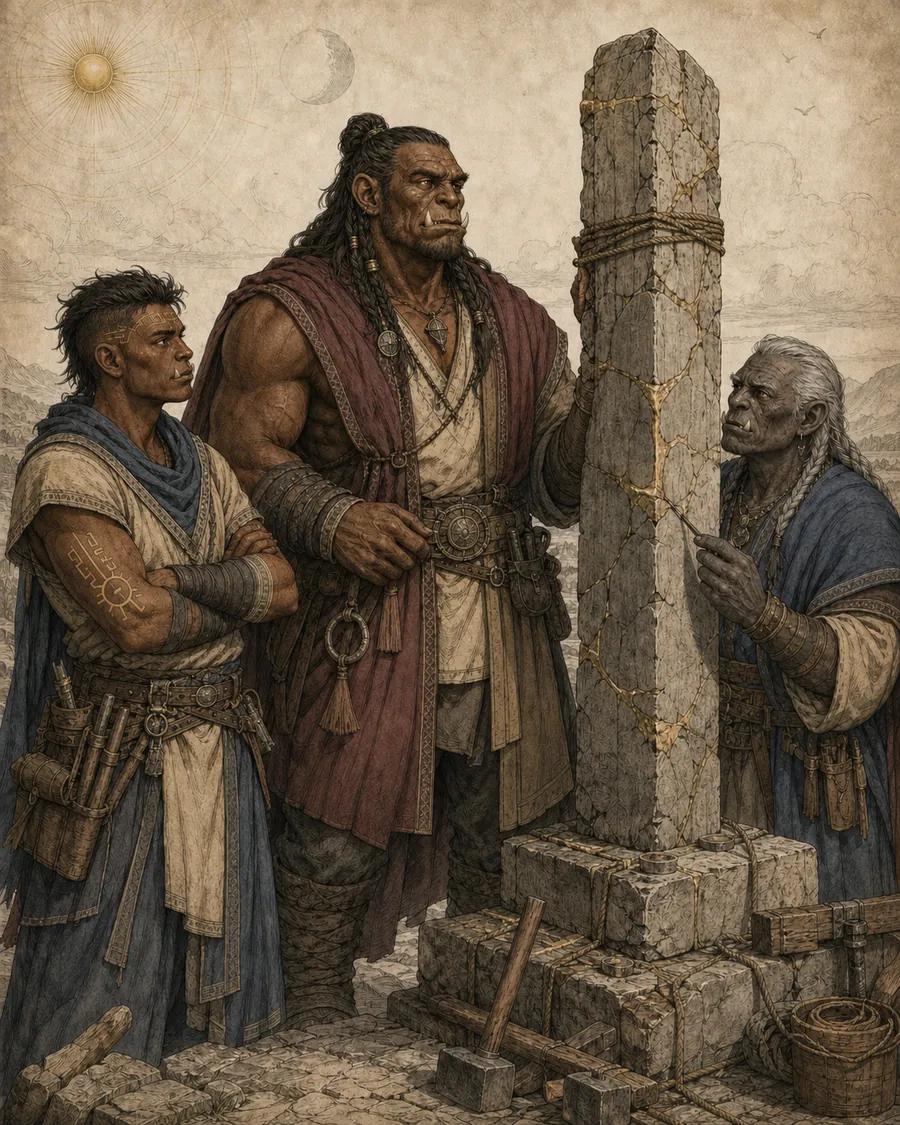
Orcs are the people of a restored covenant. Before the old catastrophe, orc lineages served an ancient custodial function tied to sacred marks, standing stones, and the protection of the world itself. During the long twilight age, that function was forgotten or reduced to rumor. In the reconstruction age, orc society is experiencing its strongest cultural renewal in centuries.
Appearance
Orcs are tall, powerfully built humanoids with heavy bone, visible tusks, and bodies adapted for hard travel, hard labor, and close physical danger. Their skin tones vary by region and lineage. In the present era, many young orcs are born with covenant marks or develop them during childhood. These marks are treated as sacred signs, not decoration.
Age and Lifespan
Orcs usually live 60–90 years, with some elders reaching or passing 100 in stable communities. They mature quickly, but covenant cultures often distinguish physical adulthood from oath-bearing adulthood. An orc is not fully trusted with communal authority until they have proved that their strength can carry duty rather than merely win a fight.
Culture and Religion
Orc society in the reconstruction age is shaped by a single fact: the covenant has returned. During the long twilight, the ancient orc custodial tradition was reduced to fragments. Most warbands operated through dominance and survival, with religion present only as folk practice, ancestral memory, or shrines to local spirits. That period is ending.
In the present age, covenant marks appear on the bodies of many young orcs, sometimes from birth and sometimes during childhood. These marks are not decoration. They are treated as sacred signs that the old custodial duty has begun returning to the bloodline. Their meaning is being relearned. Some elders remember enough to teach. Others are working with scholars from other peoples to recover what was lost during the twilight. The Renewed Covenant is not a complete theology yet; it is a living, growing tradition that is still defining itself.
Different warbands and settlements have responded to the renewal differently. Some have reorganized themselves around covenant practice almost completely, with oath-bearing adulthood, sacred body marks, ancestral chant traditions, and the slow restoration of custodial responsibilities tied to land, memory, or threshold places. Others retain the older warband structure with covenant practice present only at the margins. A few reject the renewal entirely, suspicious of any tradition they cannot test through immediate strength. Orc society is therefore uneven in the reconstruction age. The renewal is real, but it is not universal, and arguments about what the covenant actually requires can divide families, warbands, and entire regions.
Strength remains culturally central. The renewal has not replaced the orc emphasis on physical capability, demonstrated worth, and the discipline of combat. It has added a layer of duty above strength. An orc who is strong but cannot carry a covenant oath is now respected less than one who can do both. Strength is still necessary. It is no longer sufficient.
Loyalty in orc society is still expressed through the warband, the family, and the oath. Outsiders may earn trust slowly and may be received with respect once trust is earned, especially if they have demonstrated understanding of the renewal rather than only curiosity about it. The covenant tradition has begun to recognize a small number of non-orcs as carriers of its marks or principles, usually descendants of mixed bloodlines or individuals whose work has aligned with custodial purposes.
Foundation stones, old marked artifacts, and sites associated with the original covenant are treated with rising seriousness. Settlements that hold such artifacts have become places of pilgrimage, study, and political negotiation. The objects themselves are not always understood, but they are no longer ignored.
People-Specific Traits
Orcs begin with +1 Fortitude and +1 Fight or Shoot. Their physical and elemental defenses are enhanced, gaining defense equal to half of their Fortitude, rounded down. Their default training favors body, voice, endurance, and immediate action over delicate mental or arcane discipline; Orcs suffer -1 Focus and -1 Magic.
Covenant-Iron Traditions
Orcs inherit ancestral body memory and covenant force. You gain a number of free People stunts equal to your effective Fortitude. Choose that many distinct stunts from the Covenant-Iron list below; they do not use general stunt slots, and the same stunt cannot be chosen more than once. If effective Fortitude changes, adjust the number of chosen stunts with the GM. If the rating exceeds the number of listed options, the GM must approve enough additional distinct Covenant-Iron stunts to reach the required total.
-
Bonebreaker Grip. When you successfully Grapple a creature, it suffers physical damage equal to your Might. This damage cannot be reduced by defenses.
-
War Chant. Once per long rest, spending 1 AP, you may begin chanting. All allies within 10 meters gain +1 to attack rolls until the start of your next turn.
-
Savage Leap. Once per scene, you may leap up to 6 meters for 1 AP. If you land adjacent to an enemy after moving at least 6 meters, you gain +1 to your next melee attack against them this turn.
-
Ironhide Resilience. Once per scene, when you take physical damage, you may reduce it by an amount equal to your Fortitude skill.
-
Predator’s Rush. After successfully dealing melee damage, you may move up to 2 meters as a free action without provoking opportunity attacks.